Custom Foam Inserts
Die-cut EPE, EVA and PU foam cut to your product cavity, laminated to printed card, and proven with a physical sample before you commit to tooling.
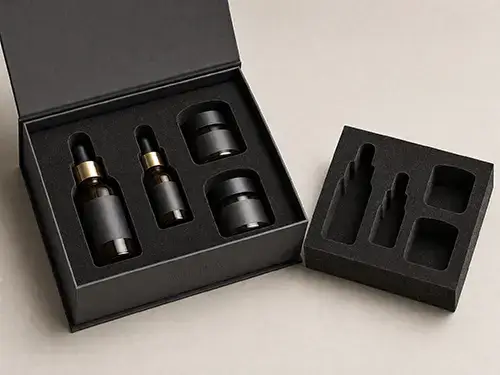
What a Foam Insert Actually Does
A foam insert is the part of the pack that stops the product moving. It fills the gap between product and carton wall, absorbs impact in transit, and presents the item when the lid opens. Where a folded card platform positions a product, foam protects it — closed-cell foam spreads a knock across the whole face instead of passing it to one edge.
We cut to your cavity rather than selling standard blocks. Send a 3D file or a physical sample and we mirror the shape, then laminate the foam to printed greyboard so the insert lifts out as one piece and reads as part of the unboxing instead of as packing material.
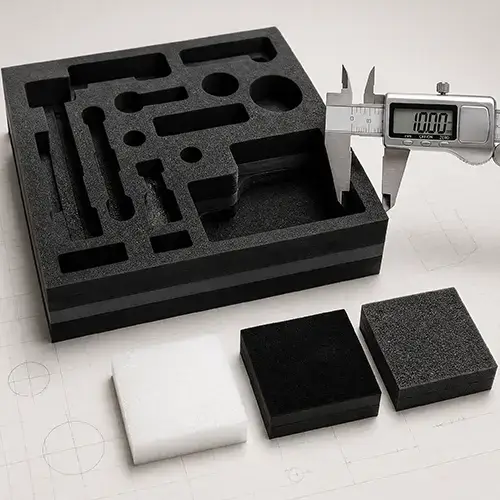
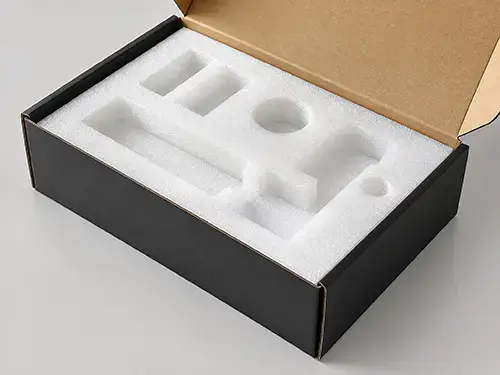
- EPE (expanded polyethylene) — closed-cell and firm, the cheapest protection per unit and the default for electronics and tools.
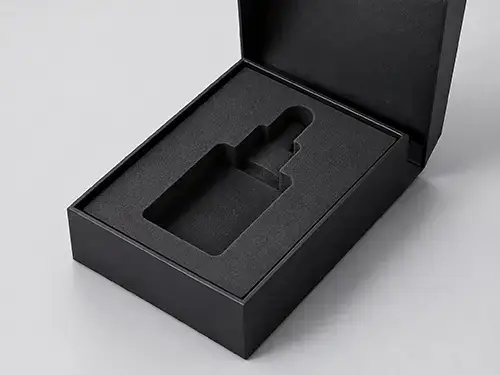
- EVA — denser and smoother, cuts into clean cosmetic cavities with a soft-touch face.
- PU (polyurethane) — the softest of the three, used where the product surface scratches if it touches anything harder.
Four Ways We Build the Insert
The foam grade protects; the construction decides how the product is presented and what the packer has to do at the table.
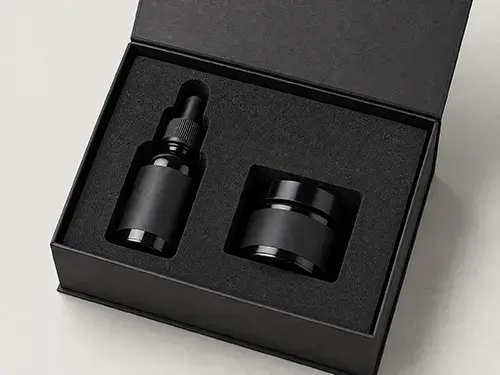
Solid die-cut block
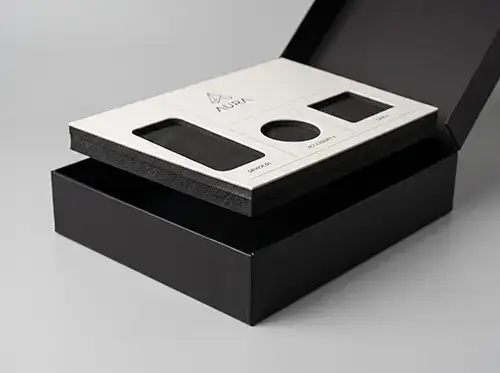
Foam laminated to card
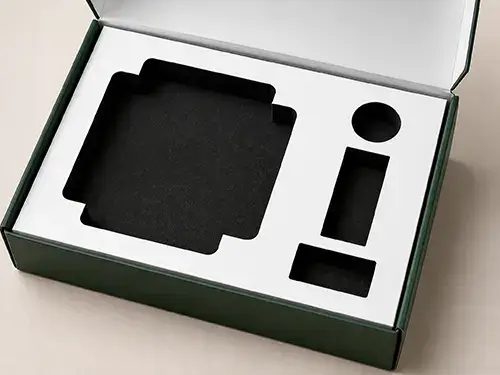
Card tray over a thin foam layer
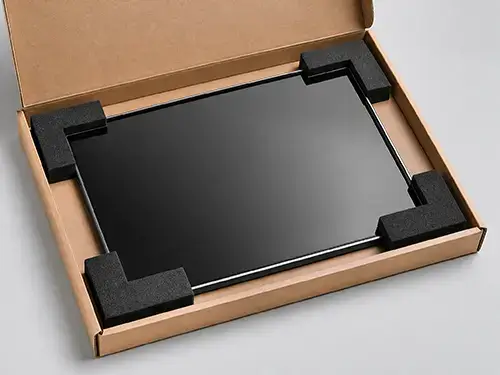
Corner fitments
Foam vs Molded Pulp vs Plastic Tray vs Card
Four insert families, four sets of trade-offs. The right answer is usually decided by weight and by the recycling claim, not by price alone.
| EPE foam | Molded pulp | Plastic tray | Card platform | |
|---|---|---|---|---|
| Protection | High — closed cell absorbs repeated knocks | Medium — rigid, can crack on a hard drop | High but rigid | Low — positioning only |
| Tooling | Die only, cheap | Mould per shape, expensive | Mould per shape, expensive | Die only, cheapest |
| Unit cost at 1,000 | Low | Low at volume | Highest | Low |
| Lead time | Fast, no mould queue | Slower — mould plus cure | Slower — mould | Fastest |
| Recycling | Specialist points only | Paper stream — curbside | PET and rPET yes, PVC no | Paper stream — curbside |
| Best for | Electronics, tools, glass bottles | Eco-led brands, cosmetics | Retail display, reusable kits | Light products, gift sets |
Foam Insert Specifications
Every custom foam inserts order is cut to your cavity. No mould, so a shape change costs a die rather than a tool.
| Foam grades | EPE, EVA, PU, XPE |
| Density | 25–80 kg/m³ depending on grade |
| Thickness | 3–100 mm; thicker sections are laminated from layers |
| Cutting | CNC contour cut, die cut, laser cutting for fine detail |
| Tolerance | ±1 mm on cavity dimensions |
| Lamination | Foam to greyboard, foam to printed card, foam to foam |
| Surface | Plain, flocked, or covered with printed card |
| Minimum order | 1,000 units |
| Sampling | Free CAD cavity check; physical sample on request |
| Production | 20–30 days after sample approval |
| Alternatives | Molded pulp or folded card where the pack must be plastic-free |
Choosing the Foam Grade
Three grades cover almost every custom foam inserts project. The difference shows up in how the product sits, how the insert cuts and what it costs.
EPE — firm and cheap
EVA — dense and clean
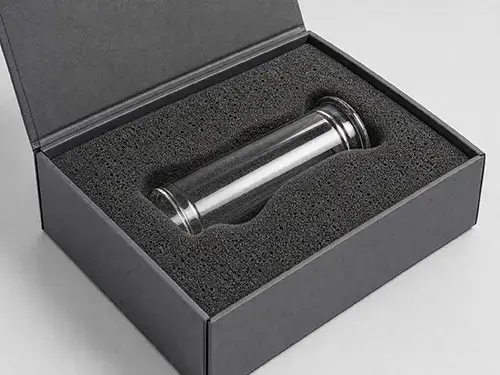
PU — softest
Where Foam Earns Its Cost
If the product cannot be replaced cheaply after a bad drop, foam is usually the cheapest insurance in the pack.
- ✓Consumer electronics and accessories
- ✓Glass bottles and jars
- ✓Hand tools and hardware kits
- ✓Cosmetic and skincare sets
- ✓Watches and jewellery
- ✓Medical and laboratory devices
- ✓Optical and measuring instruments
- ✓Subscription and sample kits
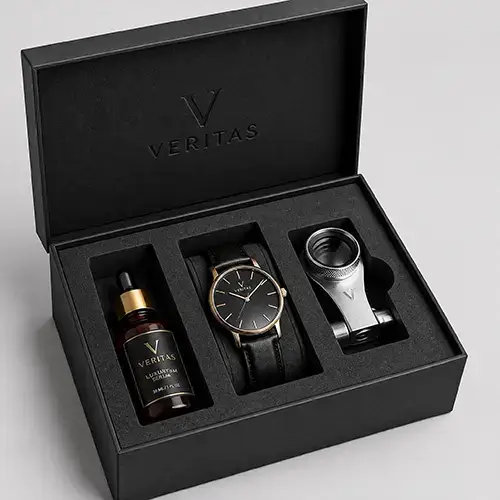
Cutting and Finishing
How the cavity is cut and finished decides how fast a custom foam inserts order loads at the packing table.
From Product to Insert
The only hard part of a custom foam inserts project is the cavity. Everything else follows.
Send the product
A 3D file, a drawing or a physical sample. We measure it and propose a cavity with the right clearance.
Confirm the cavity
We cut a sample insert so you can load the product and check the fit, the pull-out and the lid clearance.
Approve the finish
Lamination, flocking or printed card top — proofed on the actual insert, not on screen.
Produce and ship
20–30 days after approval, flat-packed with the cartons so both arrive together.
Foam Insert FAQ
EPE is closed-cell polyethylene: firm, springy, cheapest, and the standard for shipping protection. EVA is denser with a smoother cut face and a softer hand, which is why it is used where the insert is visible. PU is open-cell and the softest, so it suits high-gloss surfaces but does not hold up to repeated handling as well as EPE.
We cut a physical sample before production. Send a 3D file or the product itself and we allow 1–2 mm clearance on rigid items, 3–5 mm on products with a soft or irregular surface. You load the sample and confirm the pull-out before we cut the production die.
Not in normal kerbside collection. EPE and EVA can be recycled at specialist points, and some EU markets now require it to be separated. If the pack has to be curbside recyclable or plastic-free, we will quote a molded pulp or folded card insert instead — both work for most products under 2 kg.
Yes. Foam is bonded to 800–1,200 gsm greyboard or printed card, so the top face carries artwork, instructions or a QR code and the insert lifts out as one piece. Lamination adds roughly 1–2 mm of height and a small cost per unit.
1,000 units per design. Below that, die and set-up costs dominate and the per-unit price stops making sense — we will tell you honestly if your quantity is too low rather than quote something that will not run.
Yes, and it is common. Send the existing insert or a photo with dimensions and we will reverse-engineer the cavity. We will also tell you if the original design wastes material or over-specifies the foam, which usually means the copy costs less than the original.
Related Inserts
Folded card fitments — the cheapest insert that recycles with the box.
Your Trusted Custom Packaging Manufacturer
One-stop custom packaging service from design to global delivery — ISO 9001 certified, 100% recyclable materials, samples in 3–5 days
End-to-End Service
From concept development and structural design to sampling and mass production — all under one roof
100% Recyclable Materials
All materials are eco-friendly, supporting circular economy and carbon-neutral goals
Rapid Turnaround
Samples ready in 3–5 days. Accurate quote within 8 hours of design confirmation
10+ Years of Expertise
Serving 50+ countries with a professional team and 3M+ annual production capacity
Free Design Support
Professional structural design and graphic design recommendations at no extra cost
ISO 9001 Certified
Rigorous quality management system ensures consistent excellence across every batch

Work with Us
At Ecofriendpack, we believe in building strong partnerships that drive mutual success. Whether you’re looking to source eco-friendly packaging solutions or collaborate on innovative projects, we’re here to help.
Email Us
layne@ecofriendpack.com
Call Us
WhatsApp: +86 13559252073
REQUEST A QUOTE
Share your requirements, and we’ll provide tailored solutions at competitive prices.